

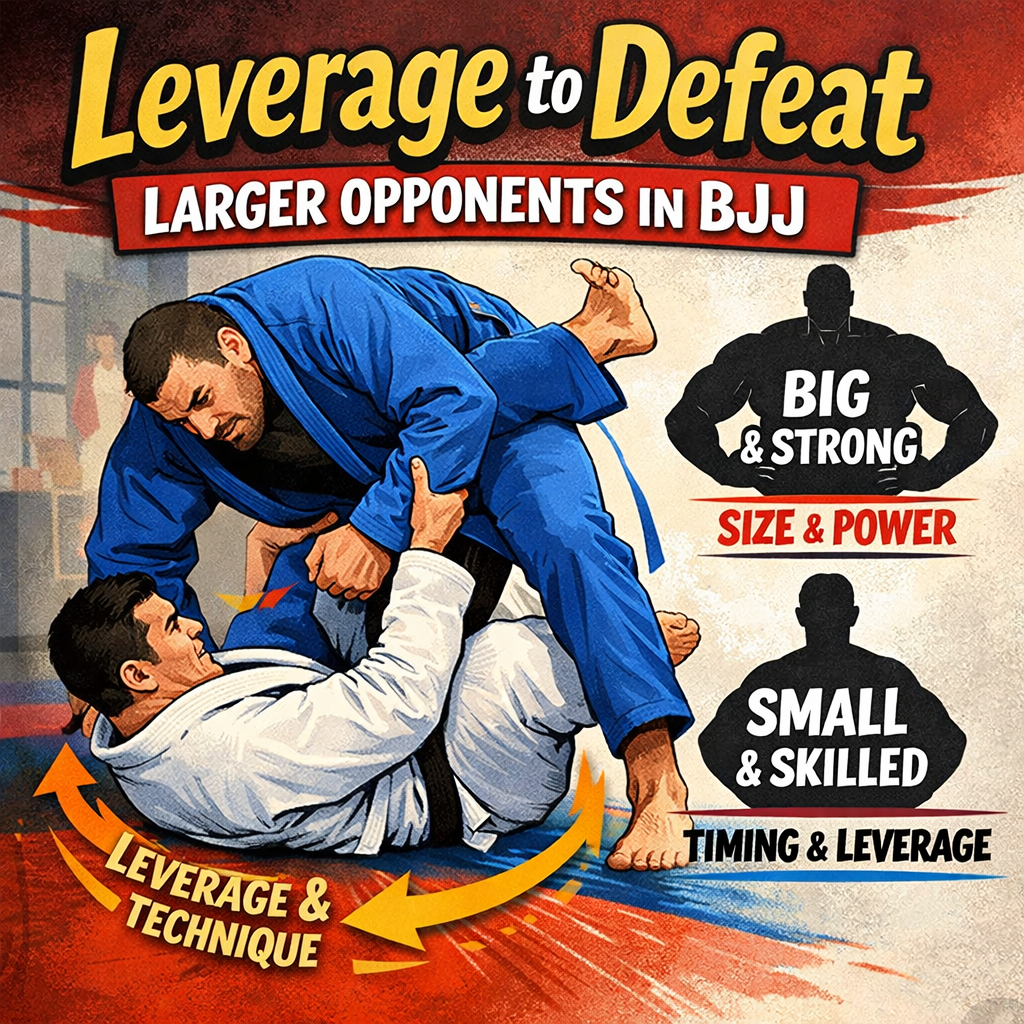
How to Use Leverage to Defeat Larger Opponents in BJJ
Brazilian Jiu Jitsu (BJJ) is often described as the “gentle art,” but a more accurate description might be the “art of applied physics.” At its core, the discipline is designed to allow a smaller, weaker person to successfully defend against and defeat a larger, more powerful attacker. This is not achieved through magic or superior aggression. Instead, it is achieved through the meticulous application of leverage. When you understand how to use your body as a system of levers and fulcrums, the physical size of your opponent becomes a secondary factor.
The challenge of facing a larger opponent is a universal experience in grappling. Whether you are a featherweight rolling with a heavyweight or a hobbyist facing a massive newcomer, the sensation of weight and pressure can be overwhelming. However, weight is only an advantage if the person using it understands how to distribute it and if you allow them to settle into a dominant position. By mastering the mechanics of leverage, you can redirect that weight, create space, and find paths to victory that do not require equal strength.
In the following sections, we will explore the fundamental principles of leverage, the importance of weight distribution, and specific technical strategies for neutralizing the physical advantages of a larger adversary. We will also discuss how Piratebjj offers Jiu jitsu madison AL for those looking to hone these skills in a structured environment.
The Fundamental Mechanics of Leverage and Fulcrums
To understand leverage in a grappling context, one must first look at the basic principles of Newtonian mechanics. In physics, a lever is a simple machine consisting of a beam or rigid rod pivoted at a fixed hinge, or fulcrum. According to the technical definitions found on Wikipedia, the force applied to one end of the lever is amplified at the other end, provided the distance from the fulcrum is optimized.
In BJJ, your limbs and torso act as the levers, while your joints or the opponent’s body parts act as the fulcrums. There are three main ways leverage manifests during a roll:
- Distance and Torque: The further away you are from the point of rotation, the more power you can generate. This is why, when finishing an armbar, you hold the opponent’s wrist rather than their elbow. By controlling the end of the “lever” (the arm), you maximize the torque applied to the “fulcrum” (your hips against their elbow joint).
- The Principle of the Wedge: A wedge is essentially a moving inclined plane. In BJJ, we use our knees, elbows, and even our heads as wedges to create space or prevent an opponent from closing a gap. If a larger opponent is trying to flatten you, inserting a knee shield acts as a wedge that redirects their downward force.
- Frame Construction: Unlike a muscle-based block, a frame uses bone alignment to support weight. When you lock your skeleton in a specific configuration, you can support hundreds of pounds without exhausting your muscles.
By shifting your perspective from “fighting” to “engineering,” you stop meeting force with force. A larger opponent will almost always win a contest of raw power. However, they cannot override the laws of physics. If you place a fulcrum in the right spot and apply pressure at the end of a long lever, their size becomes a liability because they have more mass for you to manipulate.
Neutralizing Weight Through Framing and Movement
The most common mistake smaller grapplers make is trying to push a larger opponent away. Pushing is a muscular action that consumes immense amounts of oxygen and energy. Against a heavier person, pushing is often futile because they can simply “cook” you by letting you tire yourself out against their dead weight. Instead of pushing, the elite grappler builds frames.
A frame is a structural support made by connecting your joints in a way that transfers the opponent’s weight directly into the floor. For example, if you are in bottom side control, placing your forearm across the opponent’s neck and bracing your elbow against the mat creates a structural barrier. This frame does not require active squeezing; it simply exists as a physical limit to how far the opponent can move.
Movement is the second half of the equation. While the larger person relies on static pressure, the smaller person must rely on dynamic transitions. You should never be a stationary target. By constantly moving your hips, a process often called “shrimping,” you ensure that the larger opponent never has a chance to settle their center of gravity directly over yours.
Current trends in professional grappling, often highlighted in sports research on Google News, suggest that the most successful “giant killers” are those who prioritize “off-balancing” or kuzushi. If you can keep a larger person’s hands on the mat, they cannot use those hands to grip or strike. Their weight, which was once a weapon, now becomes something they must struggle to manage just to stay upright.
Offensive Strategies: Attacking the Extremities
When you are ready to move from defense to offense, the strategy against a larger opponent should focus on isolation. You should never try to attack the opponent’s entire body at once. Instead, you isolate a single limb or the neck, effectively making the fight a “five-on-one” situation where your entire body is working against their isolated arm or leg.
Leg locks have become a primary equalizer in modern BJJ. The legs are the strongest part of the human body, but the joints within them are susceptible to the same mechanical breaking points as anyone else’s. By attacking the heels or ankles, a smaller grappler can bypass the heavy torso and powerful chest of a larger opponent.
Another effective strategy is the back take. The back is the most dominant position in BJJ because it nullifies the opponent’s ability to use their weight and reach effectively. When you are behind someone, their size no longer matters because they cannot easily reach you, and they cannot use their weight to crush you. This transition requires patience and the use of “hooks” to stay attached like a backpack, waiting for the moment to apply a choke.
Professional athletes often use these analytical approaches to overcome physical deficits, a mindset that mirrors the strategic problem solving discussed by Forbes in high-stakes environments. Success in BJJ, much like in business, comes down to resource management. You have a limited amount of strength; you must spend it only where it yields the highest return.
Conclusion and Training in Alabama
Defeating a larger opponent in BJJ is a masterclass in efficiency. It requires a deep respect for the laws of physics and the discipline to avoid “ego-wrestling” where you try to out-muscle someone who is naturally stronger. By focusing on frames, leverage, and the isolation of limbs, the smaller grappler transforms from a victim of pressure into a technician of movement.
The journey to mastering these concepts is a long one, but it is incredibly rewarding. It builds a type of confidence that is not based on how much you can bench press, but on how well you understand the mechanics of the human body. If you are in the Southern United States and looking to begin or continue this journey, Piratebjj offers Jiu jitsu madison AL. Training in a dedicated facility with experienced instructors is the fastest way to turn these theoretical principles into muscle memory.
Related Posts

Zing Sushi: Where Fresh Taste Meets Modern Japanese Style
Zing Sushi: Where Fresh Taste Meets Modern Japanese Style In today’s dining world, people want more than just good food—they want freshness, presentation, and a comfortable atmosphere. Zing Sushi delivers this combination zingsushi.com through a modern approach to Japanese cuisine that highlights quality and simplicity. Zing Sushi It is a place where tradit

Smart Contour Layering in Jawline Filler in Abu Dhabi
Introduction to Intelligent Facial Structuring Advancements in aesthetic medicine continue to transform non-surgical facial sculpting, allowing specialists to achieve refined structural definition with exceptional precision. One of the most innovative concepts gaining recognition is smart contour layering, a strategic approach that focuses on building jawline d

7 Powerful Strategies to Streamline Google Drive File Management
In today’s digital workspace, Google Drive file management has become essential for individuals and teams alike. With billions of files stored across personal and shared drives, poor organization leads to wasted time searching, duplicated efforts, and even security risks. Effective Google Drive file management not only saves hours each week but also boost

Leave a Reply