

Aerial Bundle Cable Power Transmission Technology: Smarter Overhead Distribution for Modern Utility Networks
In modern utility infrastructure, aerial bundle cable systems have become a preferred solution for safe, reliable, and efficient overhead power distribution. As grid operators, EPC contractors, and procurement teams face rising demands for network safety, lower maintenance, and faster deployment, the shift from bare overhead conductors to insulated bundled systems is accelerating.
For utilities working in urban zones, rural electrification projects, industrial parks, and temporary distribution lines, aerial bundle cable offers a practical answer to common operational pain points such as short circuits, vegetation contact, power theft, and harsh weather exposure. HNBF Power, as a global manufacturer of overhead conductors and utility cable solutions, delivers advanced aerial bundle cable systems engineered for long-term field performance and international compliance.
What Is Aerial Bundle Cable in Power Transmission Technology?
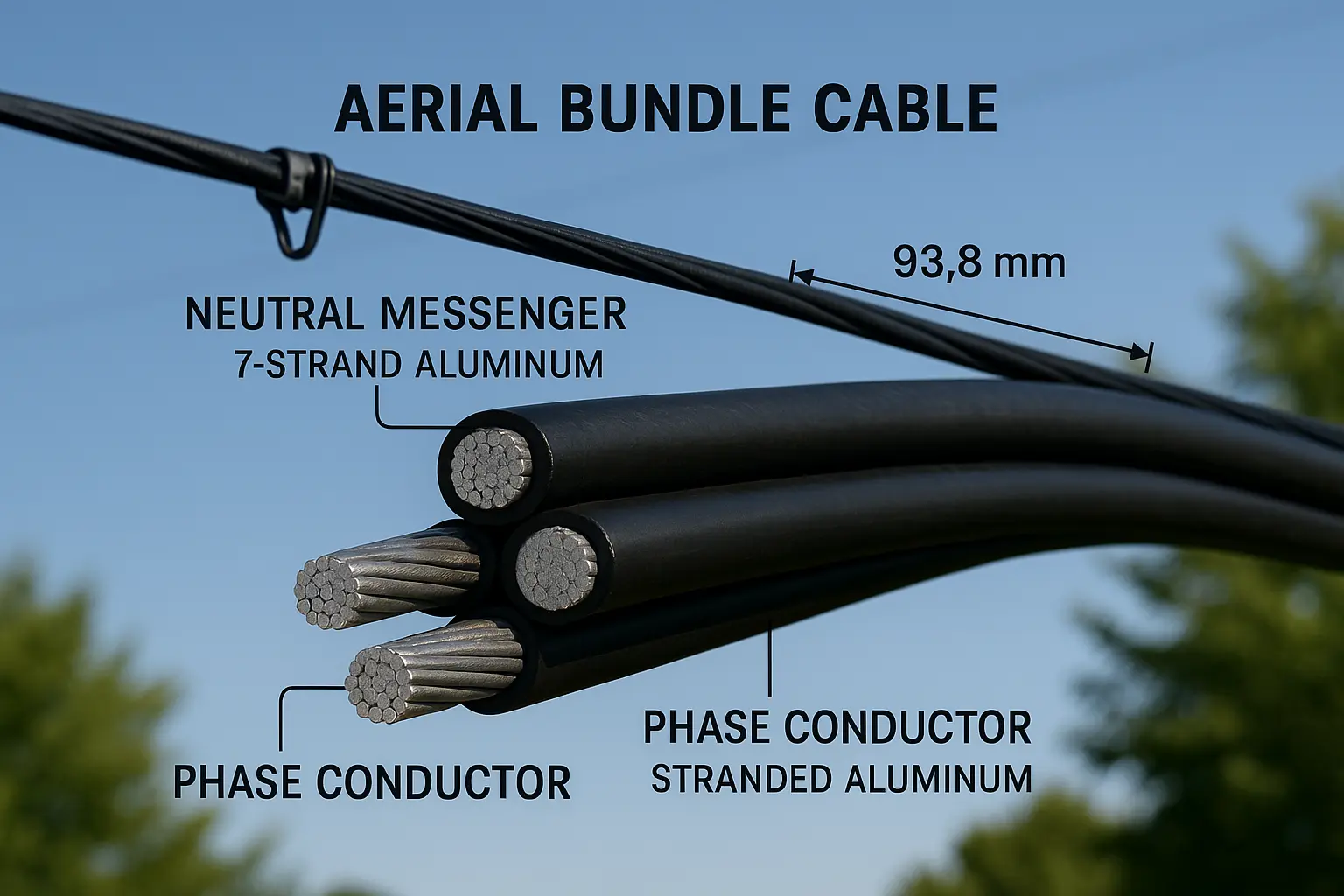
Aerial bundle cable (ABC) is a group of insulated phase conductors bundled tightly around a neutral messenger conductor, designed for overhead low-voltage and medium-voltage distribution systems. Unlike traditional bare conductors, each conductor is insulated, dramatically reducing the risk of accidental contact, flashovers, and service interruptions.
This power transmission technology is widely adopted in:
- Urban distribution networks
- Rural electrification projects
- Residential service drops
- Commercial overhead lines
- Industrial facility power supply
- Temporary construction power systems
The bundled design improves mechanical strength while simplifying installation on poles and structures.
Why Utilities and EPC Buyers Prefer Aerial Bundle Cable
For engineers and procurement professionals, selecting the right conductor system is often driven by lifecycle cost, reliability, and environmental suitability. Aerial bundle cable solves multiple field challenges.
Improved Safety in Congested Areas
One of the major issues with conventional bare conductors is accidental contact caused by trees, birds, wind-blown objects, or nearby buildings. ABC technology minimizes these risks through insulated conductors.
This makes it ideal for:
- Dense urban streets
- Residential neighborhoods
- Narrow right-of-way corridors
- Forest-edge distribution routes
The enhanced insulation layer supports safer operation where clearance limitations are a concern.
Reduced Power Theft and Illegal Connections
In many utility markets, unauthorized tapping leads to revenue loss and unstable supply quality. Aerial bundle cable makes illegal hooking significantly more difficult compared to exposed conductors.
For procurement teams focused on loss reduction strategies, this directly improves project ROI and grid efficiency.
Lower Maintenance and Fewer Faults
Traditional overhead systems often require repeated vegetation trimming and fault inspections. With aerial bundle cable, the insulated structure lowers the probability of:
- Phase-to-phase faults
- Tree branch short circuits
- Weather-related flashovers
- Bird-caused outages
This results in lower OPEX and improved service continuity for utility operators.
Key Technical Advantages for Power Distribution Projects
Superior Weather Resistance
Aerial bundle cable is designed to perform under demanding outdoor conditions including:
- UV exposure
- Rain and humidity
- Salt fog coastal environments
- High wind zones
- Extreme temperature cycles
HNBF Power manufactures ABC solutions using high-grade XLPE or PE insulation, ensuring strong dielectric performance and long-term aging resistance.
Faster Installation for Utility Contractors
From a project execution perspective, installation speed directly impacts labor cost and energization schedules. ABC systems simplify stringing and pole mounting because bundled conductors are easier to manage than multiple separated bare wires.
This benefits:
- Utility expansion projects
- Rural grid extension
- Emergency restoration work
- Fast-track EPC timelines
The result is faster commissioning and reduced field manpower requirements.
Space-Efficient Network Design
In areas where pole-top space is limited, aerial bundle cable allows compact line construction. This helps engineers optimize distribution design without compromising electrical performance.
Choosing the Right Aerial Bundle Cable Specification
Selecting the proper aerial bundle cable requires balancing electrical load, span length, environmental stress, and installation standards.
Key Selection Factors
Conductor Material
Common options include:
- Aluminum conductor
- Aluminum alloy conductor
- Neutral messenger with AAAC or steel reinforcement
Voltage Grade
Available for:
- LV 0.6/1kV
- MV 10kV–35kV systems
Insulation Type
The most common insulation materials are:
- XLPE for enhanced thermal performance
- PE for cost-effective distribution lines
Core Configuration
Typical designs include:
- Duplex
- Triplex
- Quadruplex
- Custom multi-core bundled systems
HNBF Power supports customized manufacturing based on IEC, ASTM, BS, NFC, and other project standards required by global utility buyers.
Common Pain Points Solved by HNBF Power
Procurement managers and engineers often struggle with inconsistent cable quality, delayed delivery, and non-standard specifications from suppliers. These issues can lead to installation failure, inspection delays, and increased project cost.
HNBF Power addresses these concerns through:
Consistent Manufacturing Quality
Every aerial bundle cable solution is produced with strict conductor resistance, insulation thickness, and spark testing controls.
Custom Utility Standards
Projects often require country-specific compliance. HNBF Power supports customized conductor sizing, neutral design, insulation colors, and packaging.
Reliable Global Supply Capability
For EPC contractors handling large transmission and distribution projects, stable lead time is critical. HNBF Power’s export-ready manufacturing system helps reduce procurement risk.
Applications Across Modern Grid Infrastructure
Aerial bundle cable is now widely used in modern power transmission and distribution technology for:
- Utility distribution modernization
- Rural electrification programs
- Smart city infrastructure
- Industrial park overhead supply
- Mining and temporary site power
- Renewable energy auxiliary distribution
Its flexibility makes it one of the most practical solutions for next-generation overhead distribution systems.
FAQs About Aerial Bundle Cable
What is the main advantage of aerial bundle cable over bare conductor?
The biggest advantage is improved safety and reduced fault risk due to insulated bundled conductors.
Is aerial bundle cable suitable for rural electrification?
Yes. It is widely used in rural projects because it reduces theft, withstands tree contact better, and requires less maintenance.
Which insulation is better for ABC cable?
XLPE is often preferred for higher temperature resistance, longer service life, and stronger dielectric properties.
Can HNBF Power customize aerial bundle cable sizes?
Yes. HNBF Power provides customized conductor size, voltage class, insulation type, and packaging according to project requirements.
Is aerial bundle cable cost-effective?
Yes. While the initial material cost may be slightly higher, the lower maintenance, fewer outages, and reduced theft create better long-term value.
Upgrade Your Distribution Network with HNBF Power
When utilities and EPC contractors need reliable aerial bundle cable power transmission technology, choosing the right manufacturing partner is just as important as choosing the right conductor design.
HNBF Power combines engineering-grade quality, global compliance, and customized utility solutions to help buyers improve network safety, reduce losses, and accelerate project deployment.
Contact HNBF Power today for customized aerial bundle cable solutions tailored to your transmission and distribution project requirements.
Related Posts
AAC Conductor: High-Conductivity Overhead Solution for Modern Power Distribution
In today’s evolving power infrastructure, selecting the right overhead conductor is critical for ensuring efficiency, reliability, and long-term cost performance. Among the most widely used solutions, the AAC conductor (All Aluminum Conductor) stands out for its superior conductivity, lightweight structure, and corrosion resistance. For engineers, EPC contrac
Leave a Reply