

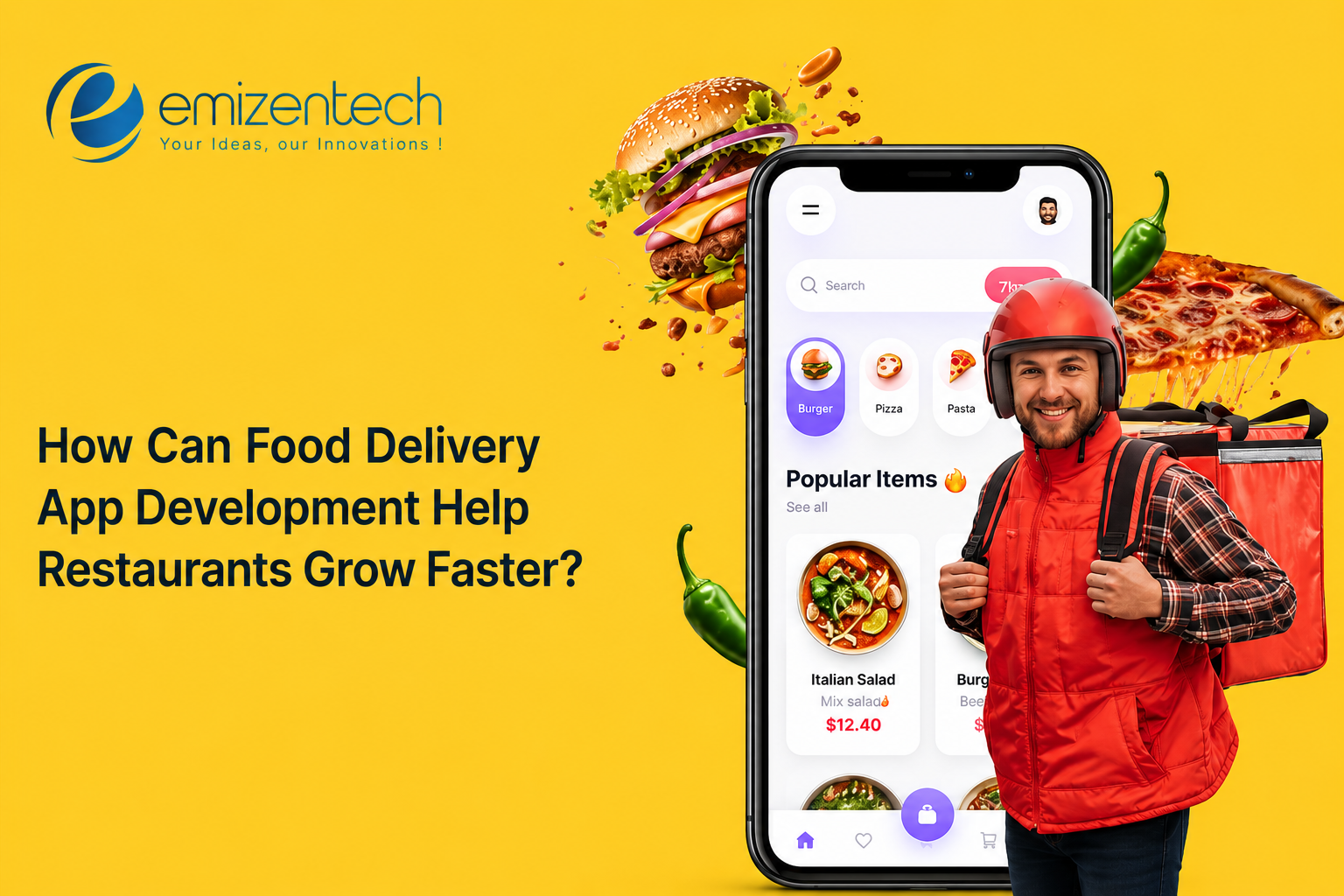
How Can Food Delivery App Development Help Restaurants Grow Faster?
The food industry has undergone a massive digital transformation in recent years, and restaurants are rapidly adapting to meet changing customer expectations. With the rise of smartphones and on-demand services, customers now prefer ordering food online rather than dining out or calling restaurants directly.
This shift has made food delivery app development a crucial investment for restaurants looking to stay competitive and expand their reach. Whether it’s a small local café or a large restaurant chain, having a dedicated food delivery app can significantly improve customer engagement, streamline operations, and boost revenue.
In this blog, we will explore how food delivery apps help restaurants grow faster, key features to include, cost considerations, and how to choose the right development partner.
Why Are Restaurants Investing in Food Delivery App Development?
Restaurants are increasingly investing in digital solutions to meet the growing demand for convenience. Customers today expect fast, easy, and seamless ordering experiences, which traditional methods often fail to provide, making food delivery app development a strategic move for modern businesses.
One major reason behind this shift is the increasing reliance on mobile apps for everyday services. A well-designed food delivery app allows restaurants to connect directly with customers without relying heavily on third-party platforms that charge high commissions.
Additionally, owning a dedicated app gives restaurants full control over branding, customer data, and marketing strategies. Instead of competing with multiple vendors on aggregator platforms, restaurants can build a loyal customer base through personalized offers and direct engagement.
How Food Delivery Apps Drive Business Growth?
Food delivery apps are not just ordering platforms, they are powerful tools for business growth. They help restaurants expand their reach beyond physical locations and serve a larger audience.
Firstly, these apps increase visibility. Customers can easily discover your restaurant through app listings, promotions, and search features. Secondly, they improve customer convenience by offering features like quick ordering, multiple payment options, and real-time tracking.
Another major advantage is data-driven decision-making. Restaurants can analyze customer behavior, order patterns, and preferences to create targeted marketing campaigns. This leads to higher customer retention and repeat orders.
Moreover, food delivery apps reduce dependency on third-party aggregators, allowing restaurants to save on commission fees and improve profit margins. This makes food delivery app development a smart long-term investment.
Key Features of a Food Delivery App
To ensure success, a food delivery app must include essential features that enhance user experience and operational efficiency.
1. User-Friendly Interface
An intuitive and easy-to-navigate interface ensures customers can browse menus, add items to cart, and place orders without confusion. A smooth user experience directly impacts customer satisfaction and repeat usage.
2. Real-Time Order Tracking
This feature allows users to track their orders from preparation to delivery. It builds transparency and trust while keeping customers informed about estimated delivery time.
3. Multiple Payment Options
Providing various payment methods such as credit/debit cards, digital wallets, and cash on delivery improves convenience. It also increases the chances of order completion by catering to different user preferences.
4. Push Notifications
Push notifications help engage users by sending updates on order status, special offers, discounts, and new menu items. This feature is essential for customer retention and marketing.
5. Admin Dashboard
An advanced admin panel helps restaurant owners manage orders, track sales, update menus, and analyze customer data. It simplifies operations and supports better decision-making.
Business Models for Food Delivery Apps
There are several business models that restaurants can adopt when investing in food delivery app development, depending on their goals and scale.
1. Single Restaurant Model
This model is designed for individual restaurants that want their own branded app. It allows full control over operations, customer data, and pricing without relying on third-party platforms.
2. Aggregator Model
In this model, multiple restaurants are listed on one platform where customers can browse and order. It requires higher investment but offers scalability and the ability to generate revenue through commissions.
3. Marketplace Model
Similar to aggregators, this model connects customers, restaurants, and delivery partners. The platform acts as a middleman, managing orders and logistics while earning through service fees.
4. Cloud Kitchen Model
This model focuses on delivery-only restaurants without a physical dining space. It reduces operational costs and is ideal for businesses targeting online orders exclusively.
5. Hybrid Model
The hybrid model combines features of single restaurant and aggregator systems. It allows businesses to manage their own delivery while also partnering with third-party services for better flexibility and reach.
Choosing the right model depends on factors like budget, target audience, and long-term business strategy.
Cost of Food Delivery App Development
The cost of developing a food delivery app varies depending on features, complexity, and technology used. On average:
- Basic app (single restaurant): $8,000 – $15,000
- Mid-level app with advanced features: $15,000 – $40,000
- High-end app with AI, analytics, and multi-vendor support: $40,000 – $100,000+
Several factors influence the cost, including design requirements, platform choice (iOS, Android, or both), and backend infrastructure.
Custom features such as AI-based recommendations, loyalty programs, and real-time analytics can increase development costs but also provide a competitive advantage. While the initial investment may seem high, the long-term benefits of food delivery app development often outweigh the costs.
How to Choose the Right Food Delivery App Development Company?
Selecting the right development partner is critical for the success of your app. Start by evaluating the company’s portfolio to understand their experience in building similar applications.
Client reviews and testimonials can provide insights into their reliability and service quality. It is also important to assess their technical expertise in modern technologies and frameworks.
Communication is another key factor. A good development company maintains transparency, provides regular updates, and understands your business requirements clearly.
Additionally, ensure the company offers post-launch support, including maintenance, updates, and performance optimization. This ensures your app remains functional and competitive in the long run.
Conclusion
The growing demand for online food ordering has made digital transformation essential for restaurants. Investing in a dedicated app not only improves customer experience but also opens new opportunities for growth and revenue generation.
With the right strategy and features, food delivery app development can help restaurants expand their reach, build customer loyalty, and stay ahead of the competition. It allows businesses to take control of their operations while reducing reliance on third-party platforms.
Partnering with an experienced development company can make a significant difference in achieving success. Companies like EmizenTech have demonstrated how innovative solutions and user-focused designs can help restaurants scale efficiently in today’s competitive market.
FAQs
1. How long does it take to develop a food delivery app?
A basic app can take 4-8 weeks, while advanced apps may take 3–6 months depending on complexity.
2. Is it better to build a custom app or use third-party platforms?
A custom app provides better control, branding, and long-term cost savings compared to third-party platforms.
3. What features are essential in a food delivery app?
Key features include user-friendly design, real-time tracking, secure payments, push notifications, and an admin dashboard.
4. Can small restaurants benefit from food delivery apps?
Yes, even small restaurants can increase visibility, attract new customers, and boost sales through dedicated apps.
5. Do I need ongoing maintenance after launching the app?
Yes, regular updates and maintenance are necessary to ensure performance, security, and user satisfaction.
Related Posts
Arabica Coffee Dubai A Premium Coffee Experience in the Heart of the UAE
Dubai is known for luxury, innovation, and world-class dining experiences, and its coffee culture is no different. Over the past few years, the demand for high-quality specialty coffee has grown rapidly, making arabica coffee Dubai one of the most searched coffee trends among residents and tourists alike. From stylish cafés to premium roasteries, Dubai has bec
How to Start a Business and Get an Investor Visa in Dubai
Dubai has become a top destination for entrepreneurs and investors due to its strong economy and business-friendly environment. Starting a company here not only gives you access to global markets but also allows you to apply for a residency visa. If you follow the correct steps, investor visa dubai can be obtained easily while setting up your business. What is

جراحة شفط الدهون في دبي بتقنية نحت الجسم الموجه
مقدمة عن تقنيات نحت الجسم الموجه أعادت التطورات الحديثة في طب التجميل تعريف نحت الجسم كتخصص دقيق يركز على الدقة والتناسق الهيكلي. فبدلاً من تطبيق أساليب عامة لتقليل الدهون، تركز المنهجيات المعاصرة ع
Leave a Reply