

Nanocellulose Market Trends, Growth & Demand Forecast 2026-2034
Market Overview:
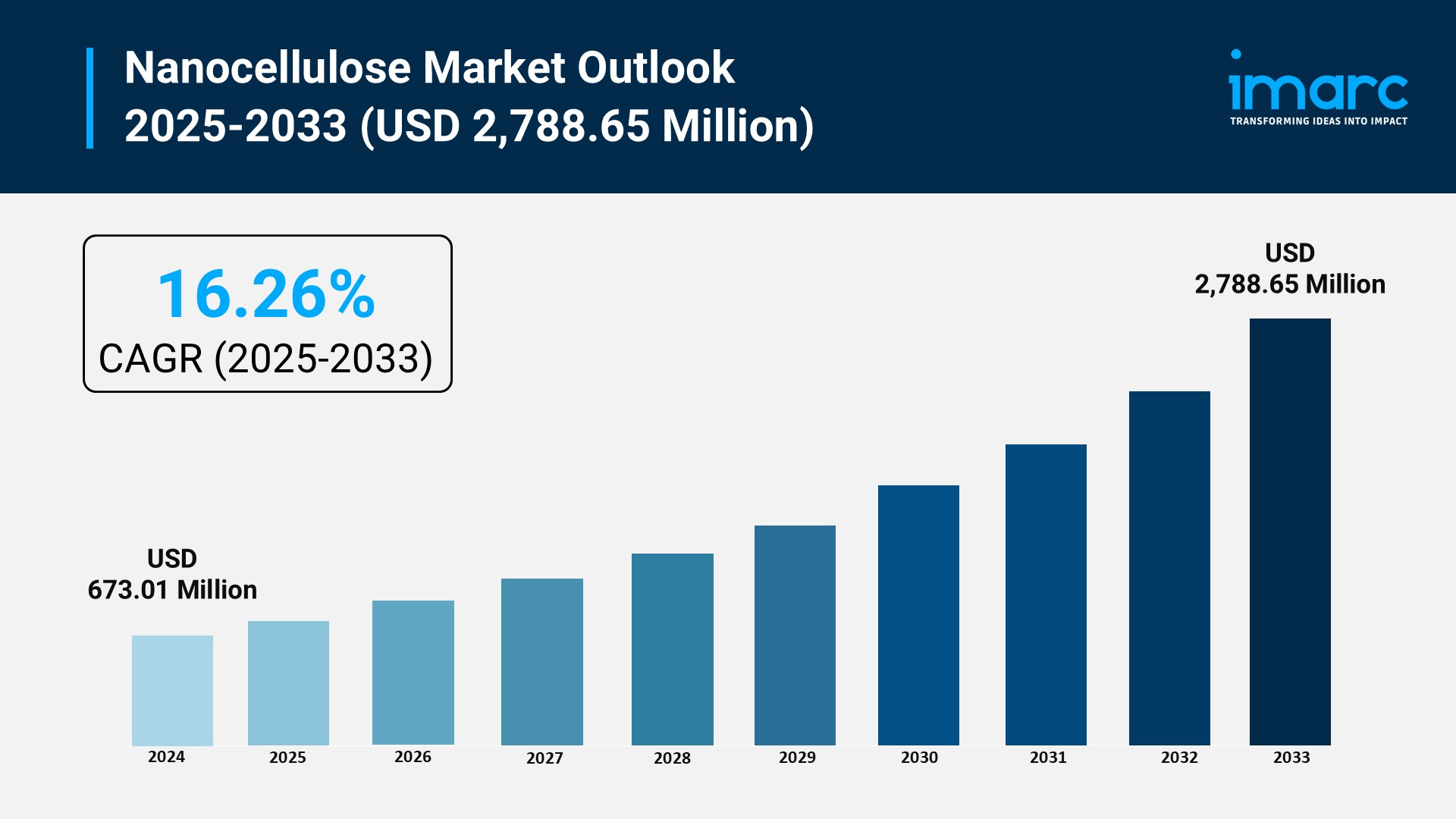
The nanocellulose market is experiencing rapid growth, driven by surge in sustainable packaging mandates, advancements in automotive lightweighting, and expansion of biomedical and pharmaceutical applications. According to IMARC Group’s latest research publication, “Nanocellulose Market Size, Share, Trends and Forecast by Product Type, Application, and Region, 2025-2033”, The global nanocellulose market size was valued at USD 673.01 Million in 2024. Looking forward, IMARC Group estimates the market to reach USD 2,788.65 Million by 2033, exhibiting a CAGR of 16.26% during 2025-2033.
This detailed analysis primarily encompasses industry size, business trends, market share, key growth factors, and regional forecasts. The report offers a comprehensive overview and integrates research findings, market assessments, and data from different sources. It also includes pivotal market dynamics like drivers and challenges, while also highlighting growth opportunities, financial insights, technological improvements, emerging trends, and innovations. Besides this, the report provides regional market evaluation, along with a competitive landscape analysis.
Download a sample PDF of this report: https://www.imarcgroup.com/nanocellulose-market/requestsample
Our report includes:
- Market Dynamics
- Market Trends and Market Outlook
- Competitive Analysis
- Industry Segmentation
- Strategic Recommendations
Growth Factors in the Nanocellulose Market
- Mandatory Shift Toward Sustainable Packaging
The urgent global transition away from single-use plastics is the primary catalyst driving nanocellulose material market adoption. As governments implement stricter environmental mandates, such as the EU’s requirement for the packaging sector to reach a 50% composition of recyclable or compostable materials by 2030, manufacturers are turning to nanocellulose to bridge the performance gap. Unlike traditional bioplastics, nanocellulose provides superior gas barrier properties; barrier-grade coatings with less than 1% nanocellulose loading can reduce oxygen transmission rates by 10% to 30%. This technical efficiency allows food and beverage companies to maintain shelf life while meeting sustainability goals. Major investments reflect this shift, such as Stora Enso’s commitment of over USD 1.04 billion to upgrade fiber-based packaging facilities. Furthermore, market data shows that sustainable materials now command price premiums of 18% to 23%, incentivizing companies to invest in these bio-based alternatives despite higher initial production costs compared to synthetic incumbents.
- Government Funding and Biopharma Initiatives
National strategic priorities are increasingly focusing on “frontier sectors,” where nanocellulose plays a critical role due to its biocompatibility. For instance, the Union Budget 2026-27 in India has proposed the Biopharma SHAKTI initiative with an outlay of ₹10,000 crores (approximately USD 1.2 billion) over five years. This funding aims to bolster the domestic production of biologics and biosimilars, where nanocellulose is utilized for advanced drug delivery and tissue engineering. Similarly, in Europe and North America, public-private partnerships are accelerating the scale-up of production facilities to meet medical-grade standards. These initiatives are designed to reduce import dependency and establish regional hubs for high-value biomaterials. By integrating nanocellulose into clinical trial networks and national pharmaceutical education systems, governments are providing the necessary infrastructure for the material to move from laboratory settings to large-scale, commercially viable medical applications, particularly in the production of hydrogels and specialized wound dressings.
- Advancements in Large-Scale Manufacturing
The industrialization of nanocellulose is being propelled by new manufacturing techniques that lower the barriers to entry for heavy industries like automotive and construction. Innovations in extrusion, electrospinning, and 3D printing have transitioned the material from gram-level laboratory batches to industrial-scale production measured in tons per day. For example, some leading facilities now boast a capacity of 300 tons per annum, allowing for a consistent supply chain that was previously non-existent. In the automotive sector, nanocellulose is increasingly used to replace glass fiber in polymer composites; it offers equivalent toughness but at a significantly lower weight, which is essential for improving the range of electric vehicles. Recent industrial trials indicate that nanocellulose-reinforced composites can achieve a market value of nearly USD 290 million, demonstrating its viability in structural applications. As production volumes exceed 50,000 metric tons annually, the industry is approaching the cost-parity thresholds needed to compete directly with premium synthetic materials.
Key Trends in the Nanocellulose Market
- Circular Economy and Agricultural Waste Valorization
A significant trend in the market is the shift in raw material sourcing from traditional wood pulp to agricultural residues like bagasse, bamboo, and seed fibers. This transition supports “circular economy” goals by turning waste from the farming sector into high-value nanomaterials. By utilizing agricultural waste, producers can avoid the environmental concerns and regulatory hurdles associated with large-scale timber harvesting. In regions like Asia-Pacific, which holds a 34% market share, companies are increasingly leveraging low-cost local feedstocks to stabilize supply chains and lower production costs. This movement is not just about sustainability but also supply security; by diversifying the biomass source, the industry becomes less vulnerable to fluctuations in the timber market. Real-world applications now include the production of “green” cement and construction additives derived entirely from crop waste, providing a carbon-neutral alternative for the building industry.
- Proliferation of Biomedical Hydrogels and “Smart” Materials
Nanocellulose is rapidly emerging as a preferred material for the next generation of “smart” medical devices and active packaging. In October 2024, the launch of FibGel, a natural injectable hydrogel made from birch wood cellulose, signaled a major leap in using these materials for internal medical applications. These hydrogels are highly effective because they can be functionalized with antimicrobial agents or conductive fillers, allowing them to respond to environmental stimuli. In the consumer sector, this trend manifests as “active packaging” that integrates nanoparticles into polymers to monitor food freshness or release preservatives in real-time. Nearly 66% of recent innovations in the sector are focused on these biomedical and smart-material uses. These applications take advantage of nanocellulose’s high surface area and tunable chemistry to create highly specialized products that offer far more than just structural reinforcement.
- Integration in Electronics and Semiconductor Coatings
As the demand for flexible and sustainable electronics grows, nanocellulose is being adopted as a biodegradable substrate for sensors and circuit boards. Its low coefficient of thermal expansion and optical transparency make it an ideal candidate for replacing petroleum-based plastics in electronic displays. In the semiconductor sector, nanocellulose-based coatings are being used to enhance the durability of components and improve electrical conductivity in certain hybrid systems. The trend is particularly strong in the United States and Japan, where research-driven adoption is high. National missions, such as the India Semiconductor Mission 2.0, are beginning to explore these bio-based materials to fortify supply chains and produce specialized equipment. By providing a renewable alternative to synthetic polymers in high-tech manufacturing, nanocellulose is helping the electronics industry reduce its long-term environmental footprint while maintaining the high performance required for modern digital infrastructure.
Leading Companies Operating in the Global Nanocellulose Industry:
- Borregaard AS
- Cellucomp Ltd
- CelluForce
- FiberLean Technologies Ltd
- GranBio Technologies
- Kruger Inc.
- Nippon Paper Industries Co. Ltd.
- Oji Holdings Corporation
- Sappi Ltd
- Stora Enso Oyj
Nanocellulose Market Report Segmentation:
By Product Type:
- Nanofibrillated Cellulose (NFC)
- Nanocrystalline Cellulose (NCC)
- Bacterial Cellulose
- Microfibrillated Cellulose (MFC)
- Others
Microfibrillated cellulose (MFC) accounts for the majority of shares with 40% market dominance due to its high mechanical strength and eco-friendly properties.
By Application:
- Pulp and Paperboard
- Composites
- Pharmaceuticals and Biomedical
- Electronics
- Food and Beverages
- Others
Composites dominate the market with 42% share, driven by exceptional mechanical strength, lightweight properties, and biodegradability for automotive, construction, and packaging applications.
Regional Insights:
- North America (United States, Canada)
- Asia Pacific (China, Japan, India, South Korea, Australia, Indonesia, Others)
- Europe (Germany, France, United Kingdom, Italy, Spain, Russia, Others)
- Latin America (Brazil, Mexico, Others)
- Middle East and Africa
Europe enjoys the leading position with 35% market share owing to strong regulatory support for sustainable materials, stringent environmental goals, and well-established pulp and paper industry infrastructure.
Note: If you require specific details, data, or insights that are not currently included in the scope of this report, we are happy to accommodate your request. As part of our customization service, we will gather and provide the additional information you need, tailored to your specific requirements. Please let us know your exact needs, and we will ensure the report is updated accordingly to meet your expectations.
About Us:
IMARC Group is a global management consulting firm that helps the world’s most ambitious changemakers to create a lasting impact. The company provide a comprehensive suite of market entry and expansion services. IMARC offerings include thorough market assessment, feasibility studies, company incorporation assistance, factory setup support, regulatory approvals and licensing navigation, branding, marketing and sales strategies, competitive landscape and benchmarking analyses, pricing and cost research, and procurement research.
Contact Us:
IMARC Group
134 N 4th St. Brooklyn, NY 11249, USA
Email: sales@imarcgroup.com
Tel No:(D) +91 120 433 0800
United States: +1-201971-6302
Related Posts
Top Reasons to Choose the Hayati Pro Ultra Plus 25000 Box of 5 Over Single Units
There’s a certain moment most people reach when convenience stops being a luxury and starts becoming a necessity. Whether it’s about gifting, personal use, or simply avoiding repeated purchases, choices begin to shift toward practicality. That’s exactly where the hayati pro ultra plus 25000 box of 5 starts to make real sense—not just as a product, but a

Common Challenges in Piping Estimation
servicesAccurate cost planning is a critical part of any construction or industrial project, and piping systems are often among the most complex components to estimate. From material selection to labour calculations, even minor errors can lead to major budget overruns. This is where professional piping estimating Services play a vital role in ensuring precise a

Product Size Charts Plugin for WooCommerce: Full Guide
The 2026 Merchants Guide: Reducing Returns with a Size Chart for WooCommerce In the world of eCommerce things are moving fast. Even the smallest thing can. Break a sale. For people selling clothes, shoes or accessories the biggest problem is not companies. It’s when people return things they bought. A lot of the time people return things because they don&

Best Vape Pods Dudley UK: Best Kits infinity Phones and Vapes
It is sometimes such a colossal burden that it is necessary to find the right Vape pods Dudley UK locals love. You just want a place that you can trust that is well versed in distinguishing between a decent kit and a shabby replica with all the gadgets that are flooding the stores by the week. Infinity Phones & Vapes, that is what we boast to be, it is a pl
Leave a Reply