

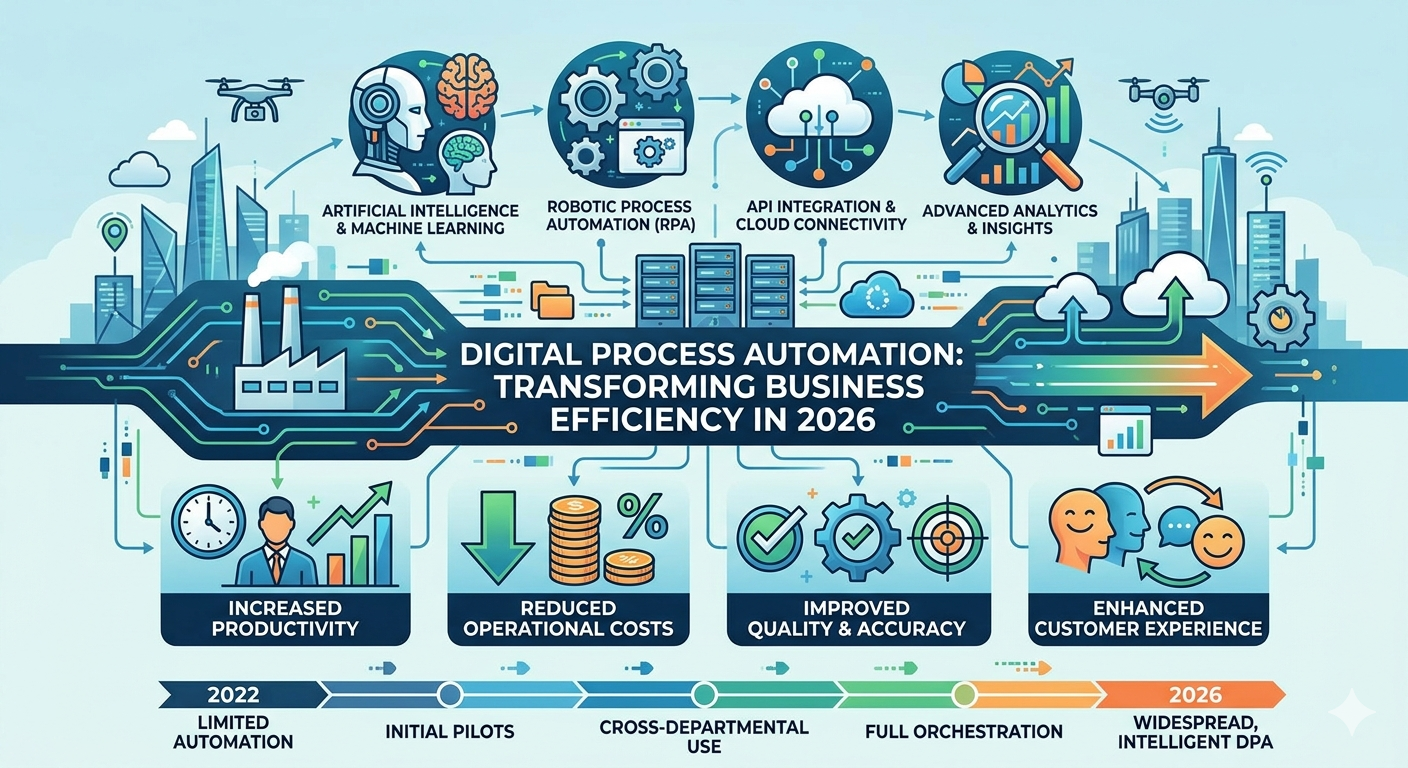
Digital Process Automation: Transforming Business Efficiency in 2026
Speed has quietly become the deciding factor in business performance. Teams are expected to move faster, respond quicker, and deliver results without friction. That pressure is exactly why Digital Process Automation is gaining serious traction. It replaces repetitive, manual workflows with systems that run in the background, handling tasks with consistency and accuracy.
Most companies do not struggle because of lack of effort. They struggle because of broken processes. Manual approvals, scattered data, and disconnected systems create delays that pile up over time. According to McKinsey & Company, nearly 60 percent of all occupations could automate at least 30 percent of their activities. That is a massive opportunity sitting right in plain sight.
The takeaway is simple. If processes are slow, the business slows down. Automation is no longer optional. It is a competitive necessity
From Manual Chaos to Structured Workflows
Let’s be honest. Many business operations still rely on emails, spreadsheets, and manual follow-ups. That setup might work in the early days, but it quickly turns into chaos as operations scale. Digital Process Automation brings structure by standardizing workflows and reducing dependency on human intervention.
Think about something as basic as invoice processing. In a traditional setup, invoices are reviewed manually, approvals are delayed, and errors slip through. With automation, invoices can be captured, validated, routed, and approved without constant oversight.
The numbers back it up. International Data Corporation reported that organizations using automation technologies see productivity improvements of up to 40 percent. That is not a marginal gain. That is a shift in how work gets done.
Real-world scenario. A logistics company implemented automated dispatch workflows. Tasks that previously required multiple calls and manual coordination were handled through a centralized system. The result was faster turnaround times and fewer operational bottlenecks.
Automation does not remove people from the process. It removes unnecessary friction.
The Technology Stack Driving Automation Forward
Automation in 2026 is not built on a single tool. It is a combination of technologies working together to streamline operations. Digital Process Automation integrates tools like workflow engines, artificial intelligence, and robotic process automation to create a seamless system.
Platforms from companies like UiPath and Automation Anywhere have made it easier to automate complex workflows without deep technical expertise. These tools can mimic human actions, process data, and trigger workflows across different systems.
Artificial intelligence adds another layer by enabling systems to make decisions based on patterns and data. This is particularly useful in areas like customer service, fraud detection, and predictive maintenance.
Here is a stat worth paying attention to. Gartner predicted that by 2025, 70 percent of organizations will implement structured automation to improve operational efficiency. That shift is already happening.
The businesses adopting these technologies early are setting the pace. Everyone else is trying to catch up.
Automation Delivers the Biggest Impact
Not every process needs automation, but the right ones can create immediate value. Digital Process Automation works best in areas with high repetition, clear rules, and measurable outcomes.
Customer onboarding is a strong example. Instead of manual data entry and back-and-forth communication, automated systems can collect information, verify details, and activate accounts in a fraction of the time.
HR operations also benefit heavily. Tasks like employee onboarding, leave management, and payroll processing become more accurate and less time-consuming.
Finance teams see gains as well. Automated reporting, expense tracking, and compliance checks reduce errors and improve visibility into financial data.
There is also a broader business impact. Deloitte found that companies implementing automation report significant improvements in accuracy, compliance, and operational efficiency.
The pattern is consistent. When repetitive work is automated, teams can focus on higher-value activities that actually drive growth.
What Holds Businesses Back From Adopting Automation
Despite the benefits, many organizations hesitate to move forward. The reasons are predictable. Concerns about cost, complexity, and change management often slow down adoption.
There is also a mindset issue. Some teams see automation as a disruption rather than an improvement. That thinking usually changes once the results start showing.
Implementation does not have to be overwhelming. Starting with a single process, measuring impact, and scaling gradually is often the most effective approach.
Here is the reality. Sticking to outdated workflows is more expensive in the long run. Delays, errors, and inefficiencies quietly drain resources every day.
Conclusion
Efficiency is no longer a bonus. It is a baseline expectation. Digital Process Automation gives businesses a way to meet that expectation by removing friction, improving accuracy and speeding up operations.
The shift toward automation is already underway, and the gap between automated and non-automated organizations is widening. Those who act early gain a clear advantage in speed, scalability, and decision-making.
The question is not whether automation will shape the future of business. That is already happening. The real question is how quickly organizations are willing to adapt.
The tools are available. The benefits are proven. What remains is the decision to move forward.
Related Posts

Smart Ways to Invest Money for Higher Returns
Investing plays an important role in managing money over time, especially when aligned with specific financial goals. With increased access to digital platforms and a wider range of financial products, individuals today can explore multiple ways to structure their investments. Understanding how different approaches work helps in creating a more balanced and inf

Buy Export Quality Chaunsa Mango – Premium Taste from Pakistan
When it comes to mangoes, Pakistan is globally recognized for producing some of the finest varieties in the world. Among them, the legendary Chaunsa mango stands out for its exceptional sweetness, rich aroma, and juicy texture. If you’re looking to buy export quality Chaunsa mango, this detailed guide will help you understand what makes it special, how to cho

Smart Investment Strategies for Stable Returns
Many investors look for financial opportunities that provide stability and predictable returns. In uncertain markets, people often prefer investment options that offer consistent income rather than high-risk speculation. Whether someone is new to investing or planning to diversify their portfolio, understanding stable investment models is an important step towa

Automate Your Store with WooCommerce Google Sheet Integration
The 2026 Data Blueprint: Why a Google Sheet Connector for WooCommerce Is Essential In todays moving eCommerce world data is the foundation of growth. Every WooCommerce store generates a lot of information every day from orders and inventory updates to customer activity and shipping details.. If this data stays locked inside your dashboard it becomes hard to use
Leave a Reply