

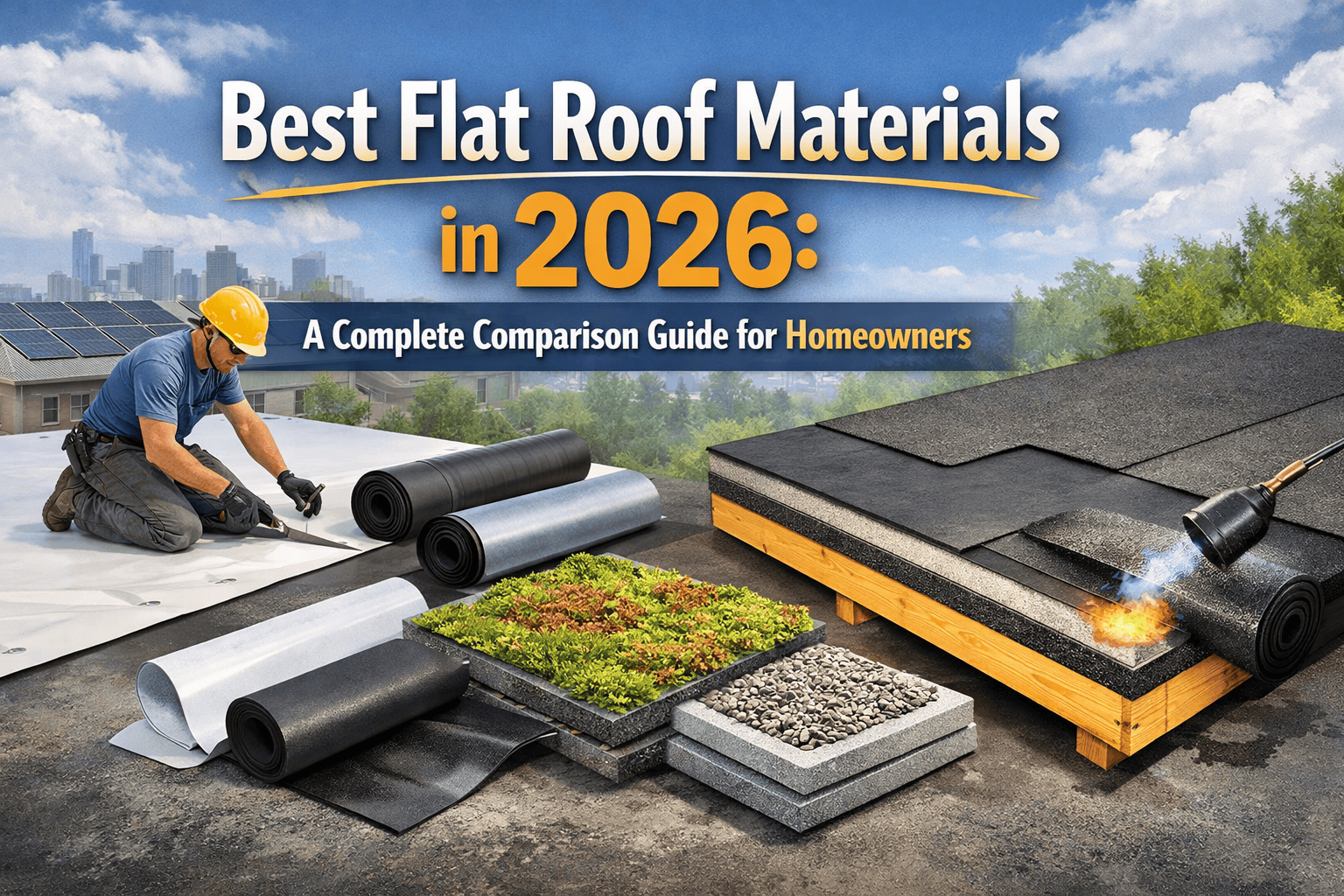
Best Flat Roof Materials in 2026: A Complete Comparison Guide for Homeowners
Choosing the right flat roof materials is one of the most important decisions you will make for your home or commercial building. Flat roofs look simple from the outside, but they require carefully selected materials to handle standing water, UV exposure, temperature changes, and long-term wear. Pick the wrong material and you are looking at leaks, premature failure, and expensive repairs. Pick the right one and your flat roof will protect your building reliably for decades. This guide covers every major flat roof material available today — including costs, lifespans, pros, cons, and which situations each one suits best.
Why Flat Roof Material Selection Matters More Than You Think
Flat roofs do not shed water the way sloped roofs do. Because water drains slowly on a flat or low-slope surface, the roofing membrane needs to be completely waterproof, flexible enough to handle temperature expansion, and tough enough to resist UV damage over many years. A material that works beautifully on a steep-slope roof can fail quickly on a flat surface.
The good news is that modern flat roof materials have advanced significantly over the past two decades. Today’s options offer impressive durability, energy efficiency, and long lifespans — as long as you choose the right material for your climate, building type, and budget. Understanding each option in depth is the only way to make a confident, informed choice.
TPO Roofing — The Most Popular Flat Roof Material Today
TPO, or Thermoplastic Polyolefin, has become the most widely installed flat roof material in the United States over the past decade. It is a single-ply membrane made from a blend of rubber and plastic that is heat-welded at the seams to create a fully waterproof surface.
TPO is known for its bright white surface, which reflects sunlight and reduces cooling costs — making it an excellent choice for homes and commercial buildings in warm climates. It is lightweight, easy to install, and resistant to UV rays, punctures, and chemical exposure. Most TPO roofs last between 15 and 25 years with proper maintenance.
The average installed cost of TPO roofing runs between $5.00 and $10.00 per square foot, making it one of the more affordable flat roof materials on the market. Its combination of performance, energy efficiency, and reasonable cost is why contractors and building owners consistently rank it as their top choice for flat and low-slope applications.
EPDM Roofing — The Proven, Long-Lasting Rubber Option
EPDM, which stands for Ethylene Propylene Diene Monomer, is a synthetic rubber roofing membrane that has been used on flat roofs for over 50 years. It is one of the most tested and trusted flat roof materials available, with a proven track record of durability in virtually every climate.
EPDM is highly resistant to extreme temperatures, UV radiation, ozone, and moisture. It remains flexible even in very cold weather, which prevents cracking and splitting during freeze-thaw cycles. A well-installed EPDM roof can last 25 to 35 years or more, making it one of the longest-lasting single-ply flat roof options.
The typical installed cost for EPDM roofing ranges from $4.50 to $9.00 per square foot. Its dark surface — usually black or dark gray — absorbs heat, which can increase cooling costs in hot climates. However, white EPDM membranes are available for buildings in warmer regions. For cold and mixed climates, EPDM remains one of the smartest flat roof material investments you can make.
Modified Bitumen — The Reliable Multi-Layer System
Modified bitumen roofing is a close relative of traditional built-up roofing (BUR) that has been engineered for improved flexibility and performance. It consists of asphalt that has been modified with rubber or plastic polymers and is installed in layers, usually two or more, to create a thick, highly durable waterproof system.
Modified bitumen is available in APP (Atactic Polypropylene) and SBS (Styrene-Butadiene-Styrene) varieties. APP is torch-applied, while SBS can be cold-applied, self-adhered, or torch-applied depending on the product. Both offer excellent waterproofing performance and good resistance to foot traffic — an important consideration for rooftop equipment access areas.
One of the advantages of modified bitumen is its layered installation, which gives it redundancy. If one layer develops a minor issue, the layers below provide continued protection. Installed costs range from $4.00 to $8.00 per square foot, and a properly maintained modified bitumen roof can last 20 to 30 years. It is a dependable choice for both residential and commercial flat roof applications.
Built-Up Roofing (BUR) — The Original Flat Roof Material
Built-up roofing, commonly called BUR or a “tar and gravel” roof, is one of the oldest flat roof materials still in use today. It is constructed by alternating layers of bitumen (asphalt or coal tar) with reinforcing fabrics, then topped with a layer of gravel or a reflective coating.
BUR systems are extremely durable, fire-resistant, and waterproof when properly installed. The gravel topping adds UV protection and ballast, and the multi-layer construction provides excellent redundancy. Many BUR roofs installed decades ago are still performing well today.
The downsides of BUR are its weight, installation complexity, and strong odors during application. It is also one of the more labor-intensive flat roof options, which pushes the installed cost to between $5.00 and $10.00 per square foot. BUR is best suited for large commercial buildings with flat roofs that require maximum durability and long service life.
PVC Roofing — Premium Performance for Commercial Buildings
PVC, or Polyvinyl Chloride, is a single-ply thermoplastic membrane that is widely regarded as one of the highest-performing flat roof materials available. Like TPO, PVC membranes are heat-welded at the seams, creating extremely strong and watertight joints that resist wind uplift and water infiltration.
PVC roofing is highly resistant to fire, chemicals, grease, and oils — making it the preferred choice for restaurants, food processing facilities, and buildings with rooftop equipment that generates grease-laden exhaust. It is also highly reflective, which contributes to energy savings in warm climates.
The main drawback of PVC is its cost. Installed prices typically range from $6.00 to $12.00 per square foot, making it one of the pricier flat roof material options. However, PVC roofs routinely last 20 to 30 years with minimal maintenance, and their chemical resistance means they hold up better than most materials in harsh environments. For commercial applications, the investment is often well justified.
Spray Polyurethane Foam (SPF) — The Seamless Insulating Option
Spray polyurethane foam roofing is a unique flat roof material that is sprayed onto the roof surface as a liquid and expands into a solid foam layer. Because it is applied as a continuous seamless coating, there are no seams or joints where water can penetrate — eliminating one of the most common failure points in flat roofing.
SPF roofing provides outstanding insulation value in addition to waterproofing, which can significantly reduce heating and cooling costs. It is lightweight, self-flashing around penetrations and edges, and can be applied over most existing roofing materials without a tear-off.
The installed cost of spray foam roofing runs between $4.00 and $7.00 per square foot. The main requirement is regular recoating — typically every 10 to 15 years — with a protective elastomeric coating to maintain its UV resistance and weatherproofing. When properly maintained, an SPF roof can last 30 to 40 years or more, making it one of the most cost-effective long-term flat roof material options.
Comparing Flat Roof Materials: Cost, Lifespan, and Best Use
Here is a side-by-side summary of the most common flat roof materials to help you compare your options clearly:
- TPO — $5–$10/sq. ft. | 15–25 years | Best for: energy-efficient commercial and residential roofs
- EPDM — $4.50–$9/sq. ft. | 25–35 years | Best for: cold climates, residential flat roofs
- Modified Bitumen — $4–$8/sq. ft. | 20–30 years | Best for: high foot traffic roofs, residential
- Built-Up Roofing (BUR) — $5–$10/sq. ft. | 20–30 years | Best for: large commercial buildings
- PVC — $6–$12/sq. ft. | 20–30 years | Best for: commercial buildings with chemical exposure
- Spray Foam (SPF) — $4–$7/sq. ft. | 30–40 years | Best for: energy efficiency, irregular surfaces
Each material has a distinct set of strengths. The best flat roof material for your building depends on your climate, budget, expected foot traffic, and how long you plan to own the property.
What to Ask Your Contractor Before Choosing a Flat Roof Material
Before committing to any flat roof material, a conversation with a qualified roofing contractor is essential. The right contractor will assess your specific roof conditions and make a recommendation based on facts, not just what they stock in their warehouse.
Key questions to ask include whether the material is appropriate for your local climate, what the manufacturer’s warranty covers and for how long, whether the contractor is certified to install that specific membrane, what maintenance will be required after installation, and whether a full tear-off is needed or if the new membrane can go over the existing roof. A reputable contractor will answer every one of these questions clearly and in writing. Never hire someone who rushes you into a decision or cannot explain the differences between flat roof material options.
Common Flat Roof Problems and How the Right Material Prevents Them
The most frequent issues with flat roofs — ponding water, membrane blistering, seam failure, and UV degradation — can all be minimized by selecting the right material and having it professionally installed. Ponding water is best addressed with TPO or PVC, both of which resist standing water exceptionally well. Seam failure is eliminated with heat-welded membranes like TPO and PVC. UV degradation is controlled through reflective surfaces and proper coatings. Choosing a material that specifically addresses your roof’s most likely failure points is one of the most cost-effective decisions you can make upfront.
Make the Smart Choice for Your Flat Roof
Whether you are re-roofing an existing flat surface or choosing materials for a new build, investing time in understanding your flat roof material options will save you money, stress, and repeated repairs over the life of your building. The right material installed by the right contractor is a combination that delivers decades of reliable, leak-free performance.
At Roofers Blog Spot, we are dedicated to helping homeowners and building owners make well-informed roofing decisions. From material comparisons to contractor selection tips, our goal is to give you the knowledge you need to protect your property and your budget — every step of the way.
Related Posts

Why the ACT Examination Is Important for Singapore Students Applying to US Colleges
The Email That Changed Everything “We regret to inform you that your application is incomplete…” That’s the email Sarah from ACSI received in January—two months after submitting her dream university application. The missing piece? Her ACT scores. She thought because the university was “test-optional,” she didn’t need

Speech Therapy Billing Codes and Radiology Billing Expert Services: A Complete Guide by Med Brigade
In the healthcare industry, accurate billing and coding are essential for maintaining a steady revenue cycle. Specialized fields like speech therapy and radiology require a high level of precision, as even minor errors can lead to claim denials, delayed payments, or compliance issues. Understanding Speech Therapy Billing Codes and the role of a Radiology Billin

Doing Business in Myanmar: Opportunities, Risks & Legal Framework
Myanmar has emerged as a strategic frontier market in Southeast Asia, offering a unique blend of untapped potential and evolving economic reforms. With its abundant natural resources, youthful workforce, and growing consumer market, the country presents compelling opportunities for investors seeking expansion in emerging economies. We explore the comp

How to Keep a Tidy Entryway
The entryway is the first impression of your home. It’s the space where you and your guests first step inside, but it’s also often where clutter accumulates. Shoes, jackets, bags, and keys are easy to toss into the entryway after a busy day, leaving the area looking chaotic. However, with a few simple strategies, you can turn your entryway into a tidy a
Leave a Reply