

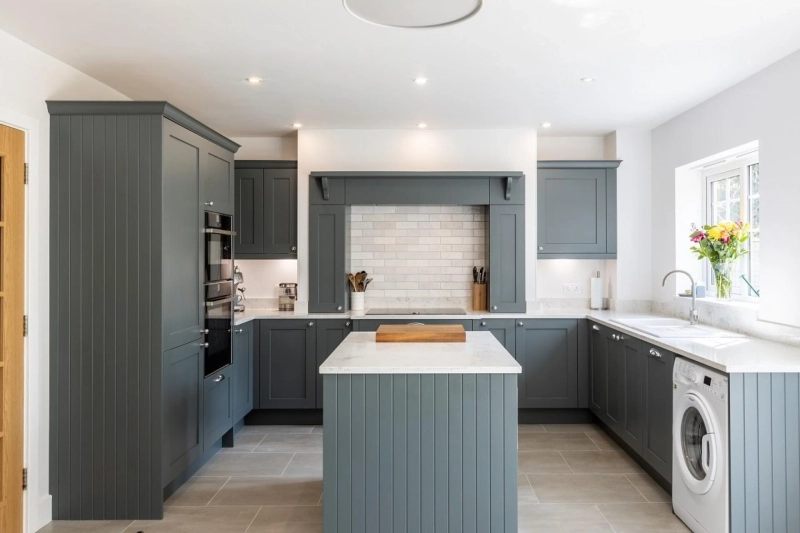
Quartzite Worktops and White Marble Worktops Compared for Style and Value
Natural Stone, Very Different Personalities
Quartzite worktops and white marble worktops are frequently placed in the same category in kitchen design conversations, both are natural stone, both can display elegant veining, and both carry a premium aesthetic that works in high-end kitchen settings. But they’re fundamentally different materials, and understanding those differences is essential before committing to either.
The Case for White Marble Worktops
White marble worktops have an unrivalled cultural cachet. Carrara, Calacatta, Statuario, these names carry associations with architecture, sculpture, and European design heritage that no engineered surface can fully appropriate. In a kitchen setting, white marble worktops bring a sense of generosity and light that’s difficult to replicate.
The veining in white marble worktops, delicate grey lines running through brilliant white, creates a surface that’s alive with visual interest while remaining fundamentally calm. Paired with white cabinetry, white marble worktops produce a kitchen that feels serene and considered. Against darker units, the contrast is dramatic and refined.
The honest conversation about white marble worktops, however, must include their maintenance demands. Marble is a relatively soft, porous stone that etches when it comes into contact with acidic substances. In a working kitchen, that means lemon juice, wine, vinegar, and tomato can leave dull, chalky marks on the surface. These marks are difficult to remove once set and become more pronounced over time.
Many homeowners choose to accept this as part of the material’s character, the ‘patina’ argument. And for kitchens that are used less intensively, or where the aesthetic of an aged surface is genuinely valued, white marble worktops can be magnificent over decades of use.
Why Quartzite Worktops Attract Serious Stone Buyers
Quartzite worktops have gained significant traction among homeowners who love the look of natural stone but want something more robust than marble. Quartzite forms when sandstone undergoes metamorphic transformation, resulting in a stone that’s considerably harder and denser than marble.
The hardness of quartzite worktops, typically around 7 on the Mohs scale, means they’re highly scratch-resistant and much less vulnerable to the daily wear that can age marble surfaces prematurely. Some varieties of quartzite worktops also display veining that’s visually similar to marble, which means buyers can achieve a similar aesthetic with better practical performance.
Varieties such as Super White, Taj Mahal, and Sea Pearl are among the most sought-after quartzite worktops on the UK market. Their pale, elegant tones and natural variation make them a genuine alternative to white marble worktops for buyers who want the natural stone look without the etching risk.
The Porosity Question
Both quartzite worktops and white marble worktops require sealing, but they respond differently to neglected maintenance. Unsealed marble etches quickly from acids and stains from oils and dark liquids. Quartzite worktops are more resistant to etching but can still absorb staining without proper sealing.
It’s worth noting that the stone trade isn’t always consistent in applying the term ‘quartzite’. Some stones sold as quartzite worktops are actually dolomitic marble, which behaves very similarly to regular marble in terms of etching susceptibility. Verifying what you’re buying with a reputable supplier is important.
Value for Money: Which Stone Justifies the Investment?
Premium quartzite worktops and high-grade white marble worktops occupy a similar price tier, both are expensive compared to quartz or granite, and both require professional installation. On pure cost terms, there’s not a clear winner.
The value calculation shifts when you factor in longevity and maintenance. Quartzite worktops, if genuinely quartzite and properly sealed, will likely look better for longer in a working kitchen than white marble worktops. But white marble worktops offer something quartzite can’t, a material with centuries of design history behind it, in a form that many homeowners find uniquely beautiful.
Both are worth the investment if chosen for the right reasons. Neither should be chosen without a clear-eyed understanding of what they demand in return.
Related Posts

France Email List: Unlocking the Power of Targeted Email Marketing
In today’s competitive digital landscape, businesses are constantly seeking innovative ways to reach potential clients and expand their market presence. Among the most effective tools for direct engagement is email marketing, and a France Email List offers unparalleled access to businesses and consumers in one of Europe’s largest and most dynamic markets. W

Samsung Battery Replacement Hastings Service
Phones are part of daily life, and when the battery starts to drain fast, it becomes stressful. Many people search for Samsung battery replacement Hastings when their phone stops holding charge. This problem is common in older devices. Batteries wear out over time, especially if you charge your phone many times a day. Heat, overcharging, and heavy apps can also

Overcome Depression with Individual Therapy
How Individual Therapy Helps You Overcome Depression: Practical Approaches That Make a Difference | Happy Lab Introduction Depression often feels like being stuck in a never-ending storm. You might try to push through your day, but everything feels heavier, slower, and harder than it should. The truth is, many people experience this—but not everyone knows whe

Essentials Hoodie Premium Comfort & Street Style Wear
Essentials Hoodie A Simple Streetwear Piece People Actually Wear (USA Guide) The essentials hoodie has become one of those clothing items you keep seeing everywhere in the USA. Not because it’s loud or flashy, but because it’s comfortable, soothing, and relaxing to sport in daily life. Streetwear has changed a lot over the past few years. People don’t lik
Leave a Reply