

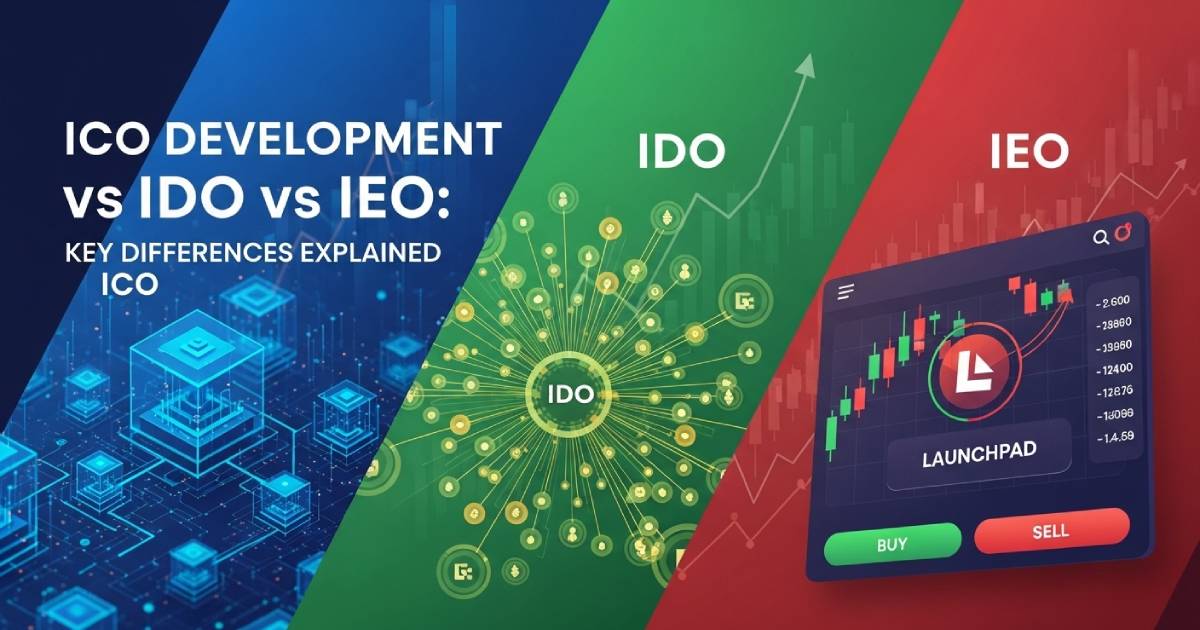
ICO Development vs IDO vs IEO: Key Differences Explained
Crypto fundraising has matured, but the confusion around launch models has not. Many teams still use ICO, IDO, and IEO as if they are interchangeable. They are not. Each model changes who controls the sale, how investors participate, what level of due diligence exists, how liquidity forms after launch, and what kind of regulatory and operational pressure a project will face. That distinction matters more in 2026 because token launches are no longer judged only by how fast they sell out. They are judged by distribution quality, compliance readiness, market structure, and what happens after trading begins. Regulatory frameworks such as MiCA in the EU have also pushed disclosure and white-paper discipline much further than the earlier token-sale era.
At the simplest level, an ICO is a token sale run by the project itself, usually through its own website or sale portal. An IEO is a token sale conducted through a centralized exchange, where the exchange manages access and participation. An IDO is a token launch conducted through a decentralized exchange or DEX-style launchpad, usually with wallet-based participation and onchain settlement. Official platform materials still reflect this split today: Binance frames Launchpad as a token launch platform tied to exchange users and identity checks, while Polkastarter describes itself as a decentralized, multi-chain fundraising platform using token pools and allowlists.
The reason these models evolved in that order is straightforward. ICOs gave teams direct access to capital, but they also created a period where disclosure quality varied wildly and investor protection was inconsistent. The SEC has repeatedly warned that token offerings can be used improperly to lure investors with promises of high returns, and it has taken enforcement action against fraudulent ICO schemes. That history is one of the main reasons the market later gravitated toward more mediated launch models such as IEOs and curated IDOs.
What an ICO really means
An ICO gives the project the highest level of control. The team designs the tokenomics, defines the sale mechanics, sets wallet rules, handles marketing, manages the smart contracts, and usually controls the investor onboarding flow. That autonomy is the main attraction. A project can structure private rounds, public rounds, vesting, bonus allocations, jurisdiction filters, and treasury logic without relying on an exchange or launchpad operator. For founders, this means flexibility. For investors, it means more responsibility. They must assess the team, token utility, lockups, legal documentation, contract risk, and the credibility of future listings with far less platform-level protection. The SEC’s long-standing position has been that investors should be especially cautious with coin offerings because none of this should be mistaken for regulatory approval.
This is why ICO development today is less about spinning up a token sale page and more about building investor-ready infrastructure. A credible ICO in 2026 needs a compliant sale flow, white-paper discipline, jurisdiction filters, KYC or eligibility checks where relevant, wallet monitoring, vesting contracts, treasury visibility, and a believable post-sale liquidity plan. Under MiCA, offers to the public in the EU now sit within a much more structured disclosure environment, including white-paper obligations and regulatory reporting architecture. That does not mean every ICO is automatically unlawful or unworkable. It means the old “launch first, explain later” model has become much harder to defend.
The strongest use case for an ICO is when a project wants direct ownership of fundraising and already has the operational maturity to handle it. That may include protocol teams with a strong community, enterprise-grade legal preparation, or ecosystems that want to control treasury formation without relying on a third-party platform. The weakness is equally obvious: because there is no built-in exchange sponsor or automatic onchain launch venue, the project must create trust on its own and then separately solve market access, liquidity, and secondary trading.
How an IEO changes the equation
An IEO shifts much of the sale process to a centralized exchange. The exchange becomes the gatekeeper. Users usually need an account, identity verification, and eligibility based on the exchange’s rules. From the project’s perspective, this reduces some technical and distribution friction. From the investor’s perspective, it adds a layer of screening, operational familiarity, and often immediate access to trading once the sale ends. Binance’s own materials describe Launchpad as a platform that helps blockchain startups raise funds while giving them access to Binance’s ecosystem, with participation tied to users who complete ID verification and meet eligibility requirements.
That exchange layer is the defining advantage of the IEO model. It can compress the path from fundraising to liquidity. It also changes the signaling effect. A project listed through a recognizable exchange launchpad borrows some of that venue’s distribution and credibility, even though it does not eliminate risk. The BitTorrent token sale on Binance Launchpad is still one of the clearest examples of the model: Binance not only hosted the sale but also positioned itself as providing launch infrastructure and advisory support, then completed token distribution directly to successful participants.
But the IEO model is not simply “safer ICO.” It introduces dependency. The exchange decides whether the project is suitable, who can participate, what compliance checks apply, how the allocation works, and when trading begins. That centralization can help reduce investor confusion, but it also means the project gives up control over onboarding, timing, geography, and in some cases messaging. It may also face meaningful listing and commercial requirements that smaller teams cannot easily meet. In other words, an IEO trades sovereignty for distribution efficiency.
Why IDOs became attractive
IDOs emerged as a reaction to the friction and gatekeeping of centralized platforms. Instead of routing token sales through a centralized exchange, IDOs use decentralized launchpads and DEX-style pools. Polkastarter describes its model as multi-chain token pools, while its participation guides explain allowlists, staking tiers, and wallet-based access rather than exchange account-based onboarding. That structure fits projects that want public token distribution to happen onchain and closer to the native Web3 user experience.
The practical appeal of the IDO is speed and composability. A project can sell tokens to wallet users, create a liquidity pool, and move quickly into open market trading. It can also tap users who already live inside DEX ecosystems rather than forcing them into exchange registration flows. In market segments driven by onchain communities, that matters. CoinGecko’s late-2025 research on launchpad-based memecoins showed how large launchpad-linked trading activity became during the recent cycle, with daily trading volume rising sharply from mid-2024 to late 2025. That does not prove every IDO is healthy, but it does show that launchpad-led onchain distribution remains a major route to early market attention.
Still, IDOs have their own weaknesses. Open access can become noisy. Community enthusiasm can outweigh diligence. Price discovery can happen too fast, especially when liquidity is thin, unlock schedules are not well understood, or whale concentration is high. Many curated launchpads try to solve this with selection criteria, staking thresholds, allowlists, cooldown periods, and vesting rules. Polkastarter’s own materials emphasize project selection standards and participation mechanics precisely because decentralized access alone is not enough to protect quality.
The core differences that actually matter
Most surface-level comparisons stop at the platform distinction. The more important differences sit deeper.
First, control. ICOs give maximum project control. IEOs give maximum exchange control. IDOs split control between the project, the launchpad mechanism, and onchain market dynamics.
Second, investor access. ICOs often use the project’s own sale portal. IEOs rely on exchange accounts and identity checks. IDOs rely more heavily on wallets, allowlists, and staking-based qualification. That changes both audience quality and conversion friction.
Third, due diligence. ICO buyers must largely trust the project and do their own work. IEO participants benefit from exchange-level screening, though that is not the same as a guarantee. IDOs vary widely: some launchpads curate tightly, others much less so.
Fourth, liquidity formation. ICOs frequently raise first and solve trading later. IEOs often move directly into centralized exchange trading. IDOs usually pair fundraising with immediate or near-immediate DEX liquidity. This one factor often shapes early token behavior more than the sale model itself.
Fifth, compliance posture. ICOs place the heaviest legal burden on the issuer because the issuer is running the sale directly. IEOs offload some gating and KYC mechanics to the exchange. IDOs sit in a more complex middle zone, because decentralized execution does not remove legal obligations tied to public offers, disclosures, sanctions, or restricted jurisdictions. MiCA’s white-paper architecture and the SEC’s long-running warnings both reinforce that token-sale structure does not erase disclosure responsibility.
Which model fits which kind of project?
An ICO makes the most sense for a project that wants capital formation on its own terms and has the legal, technical, and treasury maturity to carry that burden. This is usually a better fit for teams building long-horizon ecosystems, infrastructure products, or offerings that need customized sale logic.
An IEO suits projects that want distribution support, exchange credibility, and a shorter path to secondary-market activity. It is usually more appropriate for teams that can satisfy exchange due diligence and are willing to accept centralized constraints in exchange for reach.
An IDO is often best for community-native Web3 projects that want wallet-level participation, fast onchain price discovery, and early liquidity inside DeFi environments. It can work especially well for projects whose user base is already active on DEXs and launchpads, but it demands tighter tokenomics discipline because the market begins judging the token almost immediately.
The real takeaway in 2026
The right question is no longer “Which launch model is the most popular?” It is “Which launch model matches the project’s product, legal exposure, community behavior, and liquidity plan?” Crypto venture capital rebounded strongly through 2025, and serious capital is still flowing into the sector. At the same time, markets have become less forgiving toward weak disclosure, sloppy unlock structures, and tokens that launch without a credible use case or market design.
That is why ICO development, IDO strategy, and IEO preparation should all be treated as forms of market architecture, not just fundraising formats. The sale mechanism shapes who gets in, how trust is created, how the token trades, and how the project is judged after launch. ICOs offer freedom but demand discipline. IEOs offer distribution but reduce control. IDOs offer speed and native Web3 reach but expose the token to immediate market pressure. Teams that understand those trade-offs tend to build launches that last longer than the opening week.
Conclusion
ICO, IDO, and IEO are three different answers to the same problem: how to distribute a token, raise capital, and create an initial market. ICOs are direct and flexible, but they place the burden of trust almost entirely on the issuer. IEOs use the exchange as a distribution and screening layer, improving access to liquidity while adding centralization. IDOs lean into onchain participation and faster market entry, but they can magnify volatility if the launch is poorly structured. In 2026, the best model is not the one with the most hype. It is the one that fits the project’s operating reality, compliance readiness, and long-term token design.
Related Posts

The Complete Guide to Next-Gen Search Optimization Services in the Emirates
The digital landscape in the United Arab Emirates moves faster than a supercar on Sheikh Zayed Road. If you still think that ranking on the first page of Google is the final goal, I have some news for you. The game has changed. We are no longer just in the era of keywords and backlinks. We are in the era of answers. When a user in Dubai asks their phone for the

Building Contractors in Vellore for Sustainable and Modern Designs
Choosing the right Building Contractors in Vellore is one of the most important decisions when planning a home, villa, apartment, office, or commercial building. In today’s construction industry, property owners are not just looking for strong structures; they also want spaces that are modern, sustainable, and built for long-term comfort. With changing lifest

Bistro 555: “Casual Dining, Serious Flavor” (Because Fancy Suits Are Itchy)
Bistro 555: “Casual Dining, Serious Flavor” (Because Fancy Suits Are Itchy) There’s a myth that if you want “Serious Flavor,” you have to put on a tie, learn how to use a fish knife, and speak in a hushed whisper. We at Bistro 555 think that’s nonsense. We believe in “Casual Dining”—the kind where you can breathe, laugh
Membuka Pintu Hiburan: Menjelajahi Link Resmi Medusa88
Di era digital Alternatif Medusa88 saat ini, hiburan daring menjadi salah satu pilihan utama bagi banyak orang. Salah satu platform yang menarik perhatian adalah Medusa88. Dengan antarmuka yang sederhana dan navigasi yang intuitif, platform ini memungkinkan pengguna untuk langsung menikmati berbagai jenis permainan tanpa harus memikirkan teknis yang rumit. Kele
Leave a Reply