

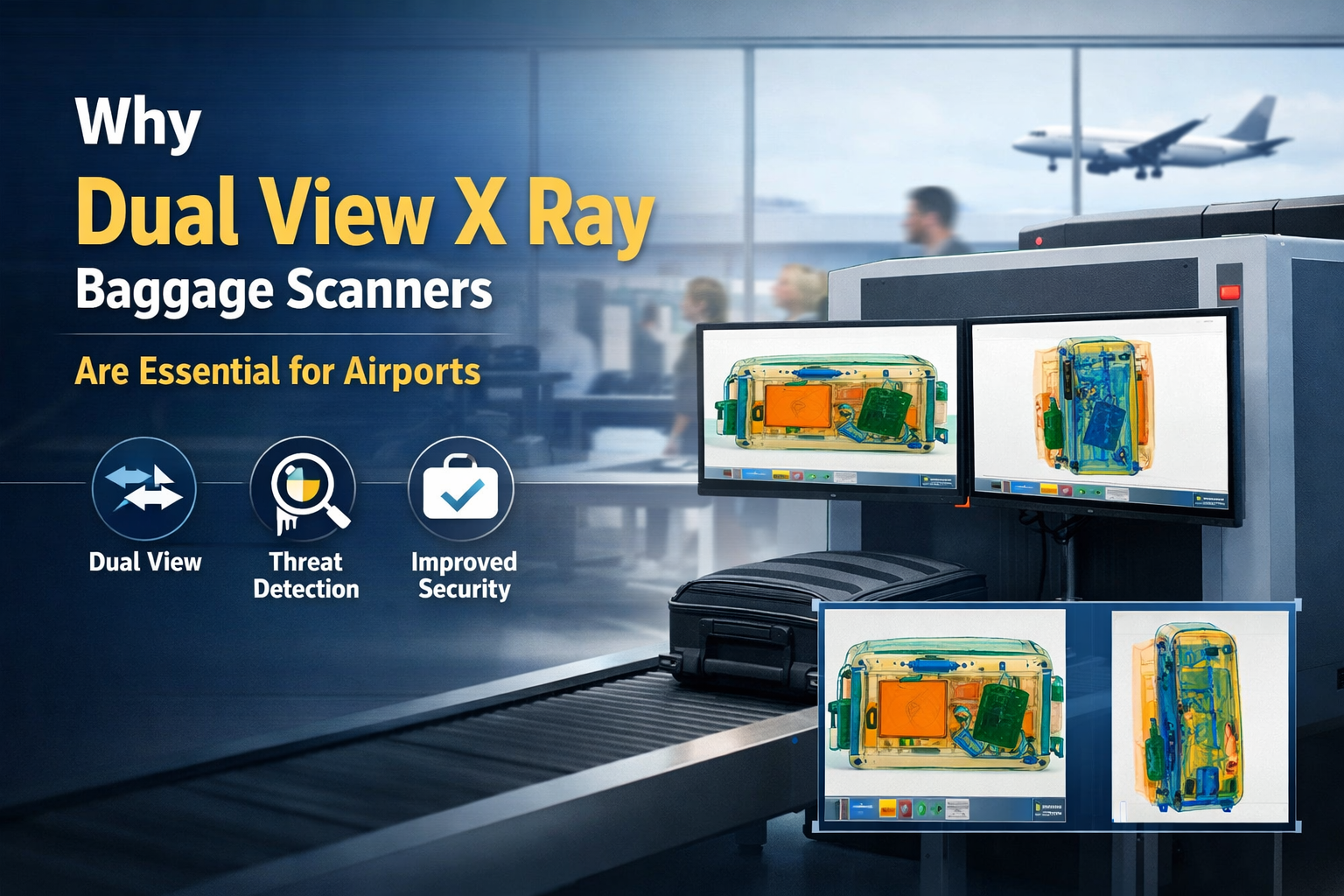
Why Dual View X Ray Baggage Scanners Are Essential for Airports
Air travel has become an integral part of modern life, connecting people, economies, and cultures across the globe. With this rapid expansion comes an equally important responsibility: ensuring the safety and security of passengers. Airports operate as high risk environments where even minor lapses in security can have significant consequences. Among the many technologies deployed to mitigate such risks, advanced baggage screening systems play a pivotal role. One innovation that has proven particularly valuable is the Dual View X Ray Baggage Scanner, a system designed to enhance detection accuracy and streamline security processes.
At its core, airport security is about making fast, accurate decisions. Security personnel are tasked with examining thousands of bags every day, often under intense time pressure. Traditional single view scanners provide only one perspective of a bag’s contents, which can make it difficult to identify suspicious items hidden behind or within other objects. This limitation can lead to uncertainty, delays, and in some cases, the need for manual bag checks. By contrast, dual view systems capture images from two different angles simultaneously, giving operators a more complete understanding of what lies inside each piece of luggage.
This improved visibility is not just a matter of convenience it directly impacts threat detection. Items that may appear harmless or unrecognizable in a single image can become clearly identifiable when viewed from a second angle. Overlapping objects, dense materials, or cleverly concealed items are far easier to analyze when multiple perspectives are available. As a result, security staff can make more confident decisions without unnecessary hesitation. In a busy airport environment, where efficiency and accuracy must go hand in hand, this capability is invaluable.
Another key advantage lies in reducing human error. Even highly trained operators can misinterpret images when visibility is limited. Fatigue, workload, and the sheer volume of baggage can further increase the likelihood of mistakes. Dual view imaging helps mitigate these risks by providing clearer, more detailed visual data. When operators are presented with better information, they are naturally better equipped to make correct judgments. This not only enhances security but also reduces the need for secondary inspections, which can slow down passenger flow and create bottlenecks.
Speed is another critical factor in airport operations. Long security queues can frustrate travelers and disrupt flight schedules. By improving the clarity of scanned images, dual view systems enable quicker decision making. Bags that would otherwise require additional checks can often be cleared immediately, allowing passengers to move through security more efficiently. Over time, this contributes to smoother airport operations and a better overall travel experience.
In addition to operational benefits, these systems also support compliance with international security standards. Aviation authorities around the world continuously update their requirements to address emerging threats. Airports must adapt quickly to these changes, often upgrading their equipment to meet stricter guidelines. A Dual View X Ray Baggage Inspection System is well suited to this evolving landscape, as it offers enhanced detection capabilities that align with modern security expectations. Investing in such technology helps airports remain compliant while maintaining high levels of safety.
The role of technology in security is not limited to detection alone. It also extends to data analysis and integration. Modern scanning systems are often equipped with advanced software that can assist operators in identifying potential threats. Features such as automatic threat recognition, material discrimination, and image enhancement tools further improve the effectiveness of screening processes. When combined with dual view imaging, these capabilities create a robust security solution that is both intelligent and reliable.
It is also worth noting the importance of adaptability. Airports vary greatly in size, passenger volume, and operational complexity. A large international hub may handle tens of millions of travelers each year, while a regional airport may deal with far fewer passengers. Despite these differences, the need for effective baggage screening remains universal. Dual view systems can be integrated into a wide range of airport environments, making them a versatile solution for both large and small facilities. Their scalability ensures that airports can expand or upgrade their security infrastructure as needed without significant disruption.
Beyond the technical aspects, there is a psychological dimension to consider. Visible security measures can influence how safe passengers feel while traveling. When travelers see advanced screening systems in place, it can instill a sense of confidence and reassurance. This perception of safety is an important part of the overall travel experience. While passengers may not fully understand the technology behind the scanners, they can appreciate the effort being made to protect them.
Environmental and operational efficiency are also becoming increasingly important in modern airport design. Many newer scanning systems are built with energy efficiency in mind, reducing power consumption without compromising performance. Maintenance requirements are often lower as well, thanks to improved engineering and more durable components. These factors contribute to long term cost savings for airport operators while supporting sustainability goals.
The evolution of Airport X Ray Baggage scanners reflects a broader trend toward smarter, more integrated security solutions. As threats become more sophisticated, so too must the tools used to detect them. Dual view technology represents a significant step forward in this ongoing process. By providing clearer images, reducing uncertainty, and enabling faster decision making, it addresses many of the challenges faced by modern airport security teams.
However, technology alone is not enough. Effective security depends on a combination of advanced equipment, well trained personnel, and strong operational procedures. Dual view scanners enhance human capabilities, but they do not replace the need for skilled operators. Continuous training and evaluation are essential to ensure that staff can fully utilize the features and benefits of these systems. When technology and human expertise work together, the result is a more secure and efficient airport environment.
Looking ahead, the future of airport security will likely involve even greater integration of artificial intelligence and automation. Dual view imaging provides a strong foundation for these advancements, as it generates the high quality data needed for machine learning algorithms to function effectively. As these technologies continue to develop, we can expect even more accurate and efficient screening processes, further enhancing passenger safety.
In conclusion, the importance of dual view baggage scanning technology cannot be overstated. It addresses key challenges in airport security by improving visibility, reducing errors, and increasing efficiency. At a time when air travel continues to grow and security threats remain a constant concern, investing in advanced screening solutions is not just beneficial it is essential. By adopting systems that provide multiple perspectives and enhanced analytical capabilities, airports can better protect passengers while maintaining the smooth flow of operations that modern travel demands.
Related Posts

Why Internal Doors Matter for Room Design and Privacy
Internal doors shape how a home feels and works. They guide movement. They control sound. They also set the mood of each room. Many people start their search with internal doors near me when they want a quick upgrade for home design. That search often leads them to better ideas and better layouts. A simple door change can shift the whole look of a house. Many h

7 Best Ways to Buy TikTok Followers Safely in 2026
In the fast-evolving world of social media, TikTok has become one of the most powerful platforms for creators, influencers, and brands looking to build visibility and influence. Growth on TikTok today is no longer accidental—it is strategic, data-driven, and highly dependent on content quality and engagement patterns. One of the most recognized platforms in t

Is It Good Time to Invest in Share Market?
Is It Good Time to Invest in Share Market | Trendy Traders Introduction Have you ever found yourself asking, “Is it the right time to invest in stock market?” You’re not alone. Whether you’re a beginner or someone who’s been watching the market from the sidelines, this question pops up again and again. The truth is, the stock market can feel like the

Waarom is de JNR Falcon 16000 zo populair onder vapers?
Vapen is een populaire keuze geworden voor mensen die houden van rijke smaken, dikke damp en gebruiksvriendelijke apparaten. Moderne vapes beschikken tegenwoordig over krachtigere batterijen, grotere e-liquidcapaciteit en een hoog aantal puffs voor langere sessies. De JNR Falcon 16000 is een opvallend apparaat dat sterke prestaties, intense smaak en een indrukw
Leave a Reply